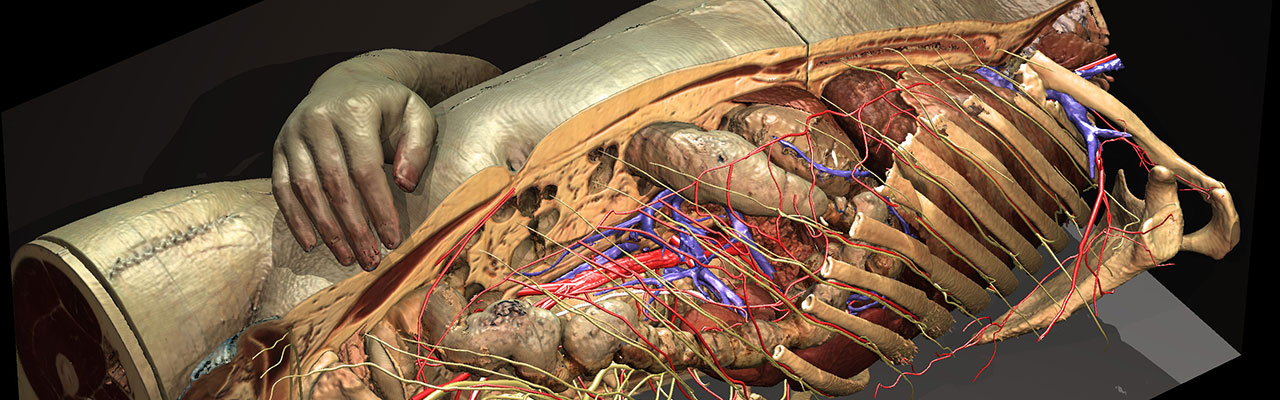
Similar to a pixel (short for picture element) in a two-dimensional digital image, a voxel (short for volume element) is the elementary component of a digital representation of a three-dimensional object. Somewhat simplified, a voxel can be thought of as a very small cube. It typically holds an intensity or color information. In more mathematical terms, it is a sampling point in a regular three-dimensional grid.
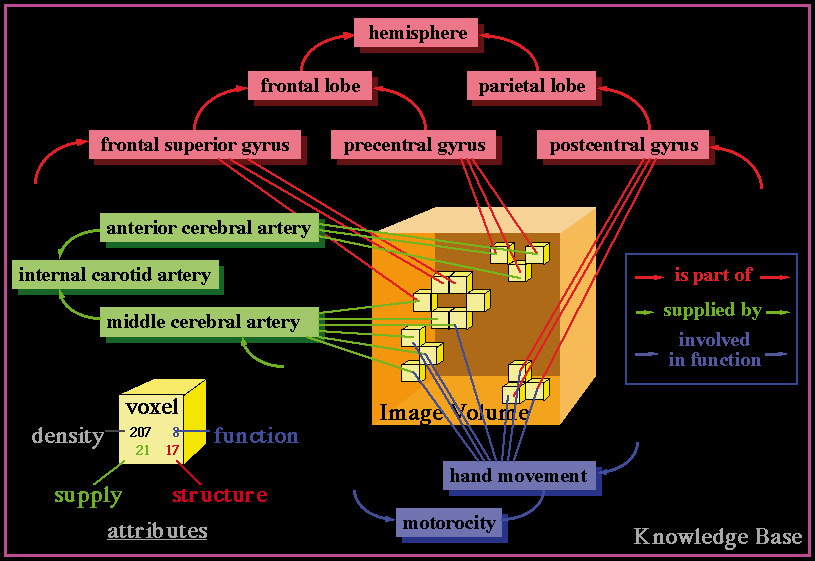 The pixels in a radiological sectional image, e.g. from computed tomography (CT) or magnetic resonance imaging (MRI), actually represent voxels, as the depicted physical property is measured in a thin slice of the body. If such images are stacked on top of each other, a 3D voxel model of the body is obtained.
Further information can be assigned to the individual voxels, e.g. the affiliation to an anatomical structure or tissue properties such as hardness or elasticity for surgery simulation. Most of our 3D visualizations, anatomical atlases and medical training simulators are based on the voxel model.
References
 Karl Heinz Höhne, Bernhard Pflesser, Andreas Pommert, Martin Riemer, Thomas Schiemann, Rainer Schubert, Ulf Tiede: A new representation of knowledge concerning human anatomy and function. Nature Medicine 1 (6), 1995, 506-511.