For a long time, the interactive visualization of medical 3D models was only possible on high-end workstations. This was particularly true for high-resolution voxel models, such as those derived from the Visible Human. To enable broader use, a different approach was needed.
Methods
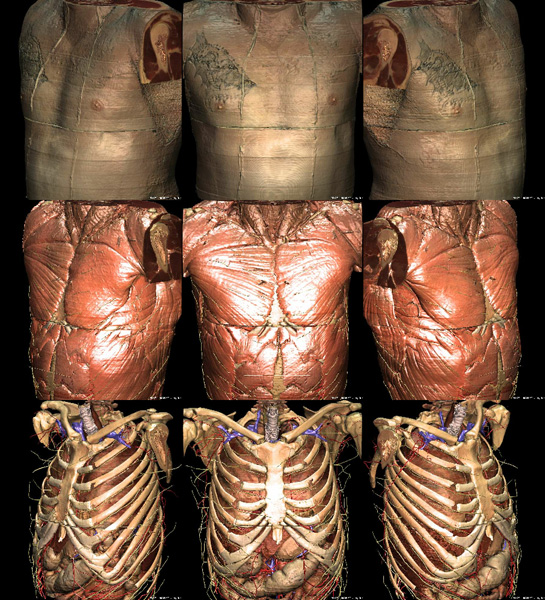 For this purpose, a new paradigm based on pre-calculated interactive scenes of the model was developed. As the base technology, the Apple QuickTime VR file format was chosen. In contrast to a linear film, a two-dimensional matrix of images is available, so that the scene can be created and explored with two degrees of freedom. This makes it perfectly suited for common 2D input devices such as a mouse or trackpad.
In a scene, the two degrees of freedom can be used in any way, for example
- Rotation of the model around two axes
- Rotation around one axis, combined with a stepwise addition or removal of anatomical layers
- Moving two orthogonal dissecting planes
As a decisive innovation, all images of the scene are extended by an invisible layer of object labels, which provide a pixel-wise link to an anatomical knowledge base. The displayed objects can thus be queried by simply clicking them in the image. Conversely, anatomical terms can be selected from the knowledge base, and the corresponding structures can be labeled, highlighted, colored, or searched for [1].
As a result, a user can explore a scene with much of the functionality of a full 3D visualization system, but in real time and with a much easier handling [2].
Applications
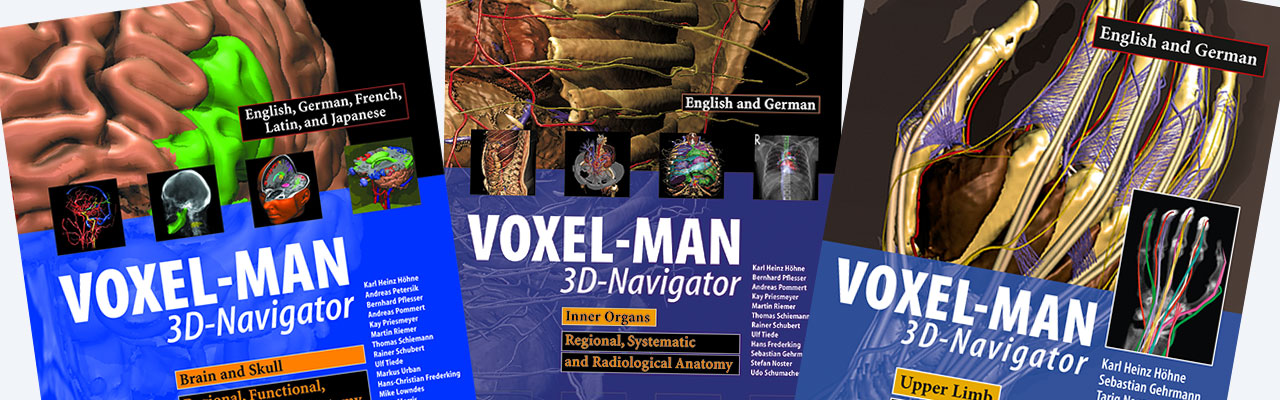
The developed methods were used for the VOXEL-MAN 3D Navigators, a series of interactive atlases of human anatomy and radiology. The following 3D Navigators were published:
 VOXEL-MAN 3D Navigator: Brain and Skull — Interactive atlas of anatomy of the brain and skull
 VOXEL-MAN 3D Navigator: Inner Organs — Interactive atlas of anatomy of the internal organs
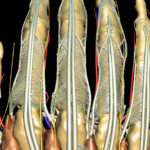 VOXEL-MAN 3D Navigator: Upper Limb — Interactive atlas of anatomy of the hand, arm and shoulder
Other applications of this technology include the Virtual Mummy and the multimedia training system EUS meets VOXEL-MAN.
References
- Rainer Schubert, Bernhard Pflesser, Andreas Pommert, Kay Priesmeyer, Martin Riemer, Thomas Schiemann, Ulf Tiede, Paul Steiner, Karl Heinz Höhne: Interactive volume visualization using “intelligent movies”. Studies in Health Technology and Informatics 62: Medicine Meets Virtual Reality, 1999, 321-327.
- Bernhard Pflesser, Andreas Petersik, Andreas Pommert, Martin Riemer, Rainer Schubert, Ulf Tiede, Karl Heinz Höhne, Udo Schumacher, Ernst Richter: Exploring the Visible Human’s inner organs with the VOXEL-MAN 3D Navigator. Studies in Health Technology and Informatics 81: Medicine Meets Virtual Reality, 2001, 379-385.