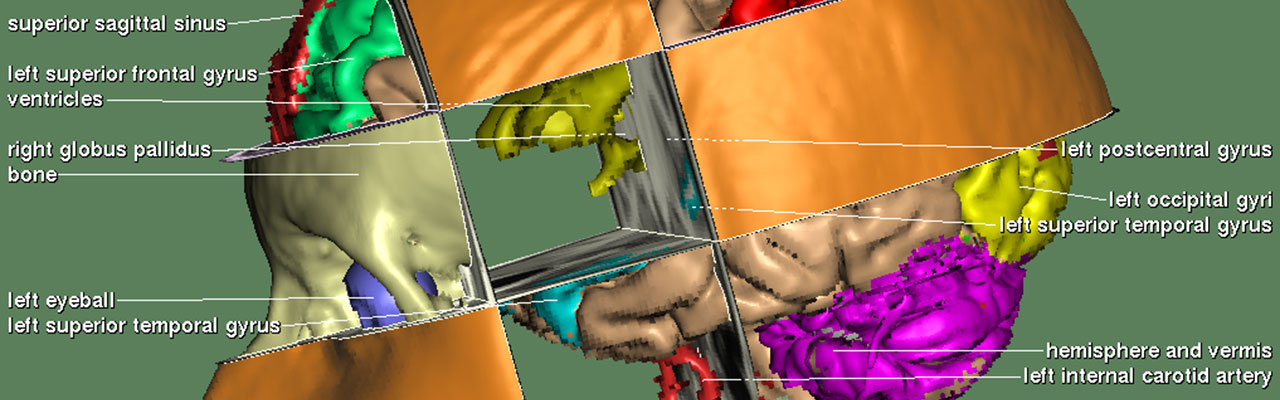
The analysis of skeletal features of fossil hominid remains is a classic approach to understanding the course of human evolution. However, studies remain largely limited to external characteristics. Virtual anthropology opens up new possibilities in this area.
As with a patient or a mummy, a CT scanner can be used to create a series of cross-sectional images of a fossil skull, from which a three-dimensional virtual model can be generated using the VOXEL-MAN visualization system. This also allows to remove any sediment matrix that may be present, cut open the skull non-destructively, and expose the hidden morphology. Missing parts can be supplemented by mirroring the intact half. In addition to visual inspection, various measurements can be taken.
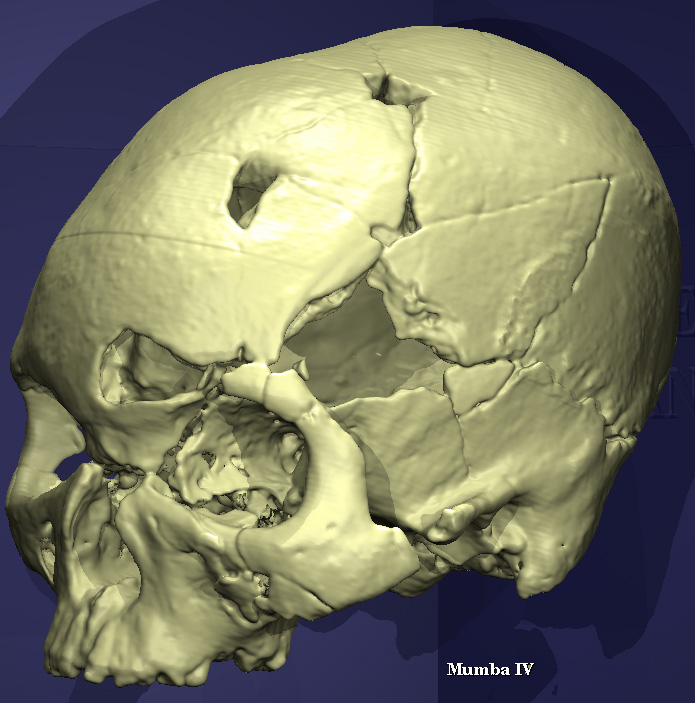
 The skull KNM-ES 11693 from Eliye Springs, Kenya (left), is particularly interesting because it exhibits both archaic and modern features. Its age is estimated at around 300,000 years. A virtual study examines its endocranial features for the first time [1], and compares them to a selection of early modern skulls from the Mumba and Strauss caves in Tanzania (below right).
 A very different virtual study compares the teeth of modern humans and other hominids [2]. It investigates the basic question of whether the number of dental roots represents an adaptation to diet, or rather reflects genetic diversity.
References
- Günter Bräuer, Christoph Groden, Flora Gröning, Angelika Kroll, Kornelius Kupczik, Emma Mbua, Andreas Pommert, Thomas Schiemann: Virtual study of the endocranial morphology of the matrix-filled cranium from Eliye Springs, Kenya. Anatomical Record A 276 (2), 2004, 113-133.
- Kornelius Kupczik, Fred Spoor, Andreas Pommert, M. Christopher Dean: Premolar root number variation in hominoids: genetic polymorphism vs. functional significance. In Elzbieta Zadzinska (ed.): Current Trends in Dental Morphology Research. University of Lodz Press, Lodz, 2005, 257-268.